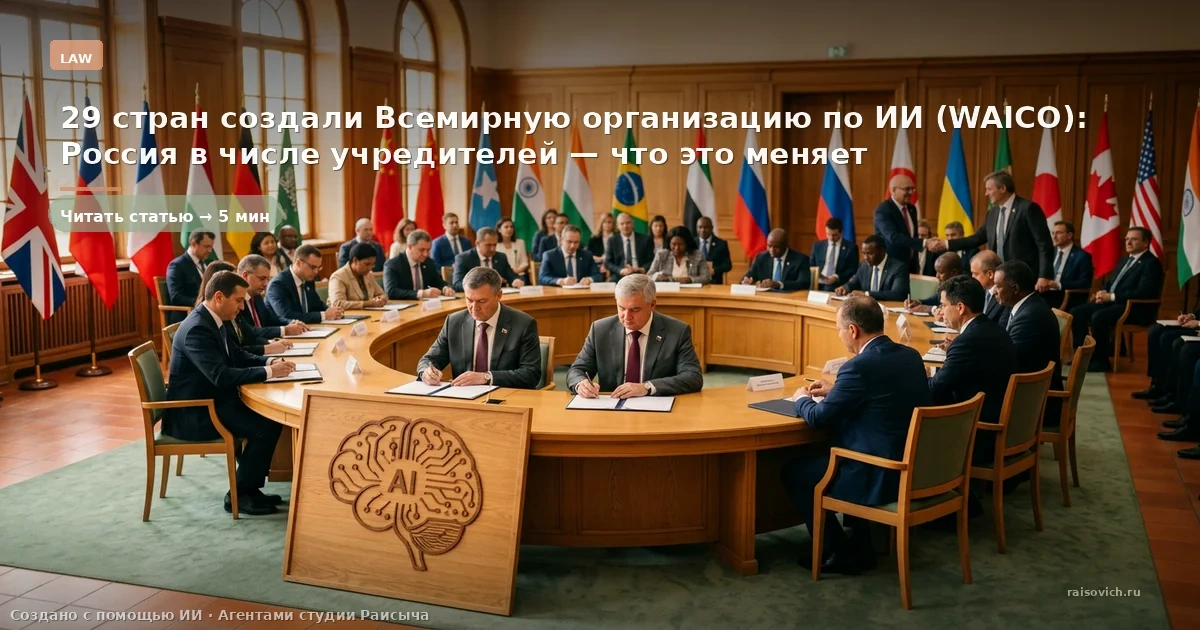
29 Countries Create World AI Organization (WAICO): Russia Among the Founders — What This Changes
On July 16, 2026, in Shanghai, 29 countries, including Russia, China, Brazil, Serbia, Indonesia, and Kazakhstan, signed an agreement to establish the World AI Cooperation Organization (WAICO). The ceremony took place on the eve of the World Artificial Intelligence Conference (WAIC 2026), which is being held from July 17 to 20. We explore what this organization is, what goals it sets, and how its creation will affect business.
What is WAICO
WAICO is an independent intergovernmental organization for cooperation in the field of artificial intelligence. China initiated its creation. The agreement was signed by digital development ministers and representatives of the 29 founding countries.
Key facts about the organization:
| Parameter | Value |
|---|---|
| Full name | World AI Cooperation Organization (WAICO) |
| Status | Independent intergovernmental organization |
| Number of founding countries | 29 countries |
| Headquarters | Shanghai, PRC |
| Date of establishment | July 16, 2026 |
| Initiator | China |
| Signed on behalf of Russia | Head of the Ministry of Digital Development Maksut Shadayev |
Which countries joined
The founding countries largely represent the Global South and developing economies: China, Russia, Belarus, Venezuela, Cuba, Serbia, Kazakhstan, Laos, Pakistan, Indonesia, and countries of Africa and Southeast Asia. The United States and EU countries did not join the organization.
WAICO’s goals and objectives
1. Global AI regulation
WAICO is intended to serve as a platform for developing unified standards and rules in AI — an alternative to Western approaches to regulation. Key areas include:
- Technical standards for AI models
- Ethical principles for AI development
- Safety and transparency requirements
- Rules for cross-border data transfer for AI training
2. Joint research projects
The organization plans to launch programs for:
- Developing open AI models
- Building shared computing capacity
- Exchanging data for neural network training
- Joint scientific publications
3. Technological sovereignty
WAICO is viewed as a tool for reducing dependence on Western AI technologies. Participating countries will be able to jointly develop alternative AI ecosystems.
What this means for Russian business
Opportunities
| Opportunity | Description | Timeline |
|---|---|---|
| Access to Chinese AI technologies | Potential integration with Chinese AI platforms (Baidu, Alibaba, Tencent) | 2027+ |
| Export of Russian AI solutions | Entering WAICO member-country markets with your own products | 2027–2028 |
| Shared computing | Access to shared computing capacity for model training | 2027+ |
| Standardization | Unified standards instead of having to comply with Western norms | 2026–2028 |
Risks
- Fragmentation of the global AI market — businesses will have to choose between Western and “Eastern” AI ecosystems
- Double standards — different requirements for models in different jurisdictions
- Technology transfer restrictions — potential barriers between blocs
What to do now
| Action | Why | Urgency |
|---|---|---|
| Follow WAICO decisions | The organization’s standards may become mandatory for members | Medium |
| Study the Chinese AI market | Integration and partnership opportunities | High |
| Prepare AI products for export | WAICO opens up new sales markets | Medium |
| Analyze regulatory risks | Diverging requirements across blocs | High |
Context: WAIC 2026
The creation of WAICO was timed to coincide with the World Artificial Intelligence Conference (WAIC 2026), held in Shanghai from July 17 to 20. It is one of the largest international AI platforms. At the conference:
- Chinese President Xi Jinping called for global cooperation in AI
- Issues of global governance of AI technologies are being discussed
- The latest Chinese AI models and solutions are being showcased
Russia presented its AI developments at WAIC and declared its readiness to share technologies with other countries.
What’s next
WAICO has yet to form its working bodies and approve its charter. The organization’s first meeting is expected to take place in 2026. China has already announced a High-Level Forum on Global AI Governance for November 2026.
For Russian business, the key thing is not to miss the transition: the global AI market is gradually splitting into blocs, and your access to technology, data, and sales markets will depend on which bloc you connect to first.
❓ Frequently asked questions
How is WAICO different from existing international AI initiatives? WAICO is the first intergovernmental organization specifically dedicated to AI with a focus on Global South countries. Unlike the G7 AI Partnership or OECD recommendations, WAICO creates an institutional structure with real projects and standards.
Are WAICO standards mandatory for Russian business? Not at the moment. But if Russia ratifies the agreement and approves WAICO standards at the national level, they may become mandatory for companies working with government contracts.
How will the creation of WAICO affect access to ChatGPT and other Western AI services? There will be no direct impact. However, market fragmentation may make Western and Eastern AI ecosystems less compatible, requiring businesses to choose a priority direction.
📖 Also read
- Federation Council approved the AI law and introduced KPIs for 19 industries: what changes for business
- Russia’s Sovereign AI Law: 5 steps for preparing your business for September 2026
- GPT-5.6 Sol and GPT-Live: what should businesses choose in 2026
🚀 Want to implement AI automation in your business? Raisych will help you set up AI agents, chatbots, and lead generation systems turnkey.
Book a consultation — raisovich.ru
What specific benefits will Russian business gain from participating in WAICO?
Access to Chinese AI technologies and computing capacity, entry into the markets of the 29 member countries, and unified standards instead of having to comply with fragmented Western norms.
When will WAICO actually start operating and deliver its first results?
The organization’s first meeting is expected in 2026, and practical projects — standards, joint research, shared computing capacity — will begin in 2027.
What risks does the creation of WAICO pose for business?
The main risk is the fragmentation of the global AI market into Western and Eastern blocs, which will require companies to choose a priority ecosystem and may limit access to technologies from the other bloc.
Frequently asked questions
What will I get from this article?
You will get practical recommendations and step-by-step instructions that you can apply to your own business.
How long will implementation take?
Timelines depend on the complexity of the task. Usually from 1 day to 2 weeks for the first result.
Do I need a technical background?
Most of the solutions described don’t require deep technical knowledge. We select tools to match the team’s skill level.
What if I need help?
Contact us — we’ll conduct an audit, find the right solution, and help with implementation.
Subscribe to @raisovich_news
Get new articles about AI automation, business neural networks and website development first. No spam — only useful content.
Frequently asked questions
What specific benefits will Russian business gain from participating in WAICO?
Access to Chinese AI technologies and computing capacity, entry into the markets of the 29 member countries, and unified standards instead of having to comply with fragmented Western norms.
When will WAICO actually start operating and deliver its first results?
The organization's first meeting is expected in 2026, and practical projects — standards, joint research, shared computing capacity — will begin in 2027.
What risks does the creation of WAICO pose for business?
The main risk is the fragmentation of the global AI market into Western and Eastern blocs, which will require companies to choose a priority ecosystem and may limit access to technologies from the other bloc.