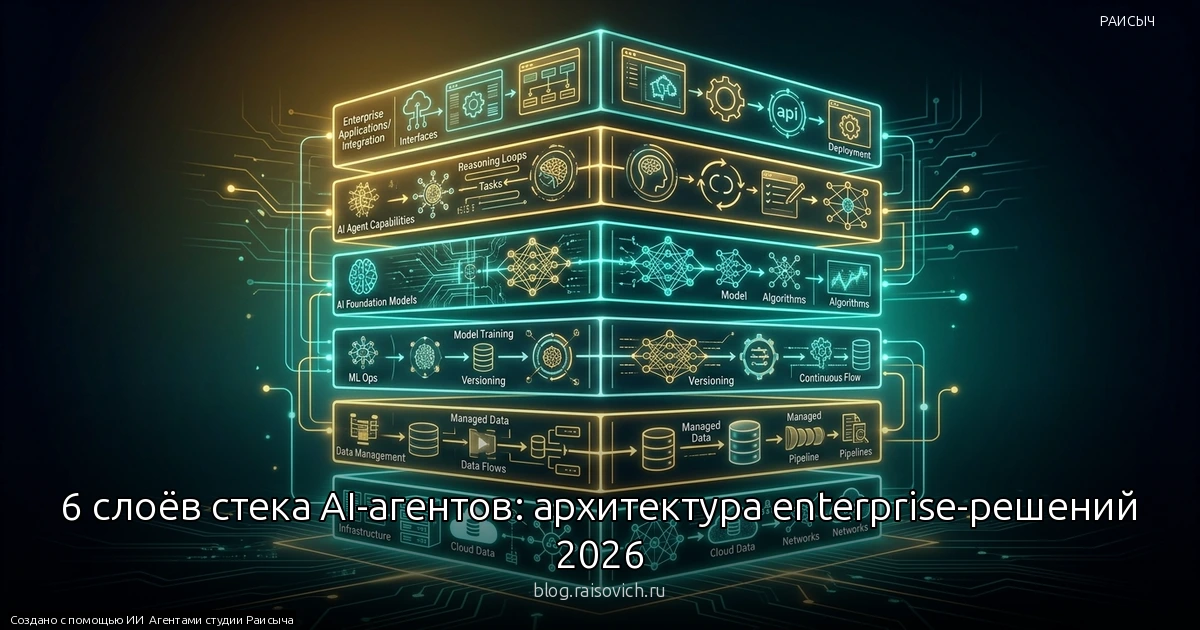
6 Layers of the AI Agent Stack: Enterprise Solution Architecture 2026
The AI agent stack in 2026 consists of six mandatory layers: the LLM model, orchestration framework, tools, memory, RAG knowledge base, and user interface. Each layer solves its own task, and the choice of components at each level determines the cost, speed, and scalability of a ready-made AI agent for business.
Breaking down the six layers of the AI agent stack is not academic theory, but a practical guide for entrepreneurs and CTOs who want to implement AI agents in their business. In 2026, the market offering is enormous: from GPT-5.6 Sol with Programmatic Tool Calling to LangGraph, AutoGen, CrewAI, and dozens of other tools. How do you avoid getting confused and build a working stack?
We build this stack as a service: AI agent development.
1. LLM Model — The Foundation of an AI Agent
The base layer is a large language model that acts as the agent’s “brain.” In 2026, the choice of LLMs is wider than ever:
| Model | Provider | Strengths | Cost per 1M tokens (input) |
|---|---|---|---|
| GPT-5.6 Sol | OpenAI | Programmatic Tool Calling, low token price | $2.50 |
| GPT-5.6 Terra | OpenAI | Multimodality, images, audio | $10.00 |
| Claude 4 Opus | Anthropic | Long context (200K), security | $15.00 |
| Gemini 3.1 Flash | Speed (up to 1000 tokens/s), low cost | $0.15 | |
| YandexGPT 4 | Yandex | Compliance with the sovereign AI law, RF data centers | 2.50 ₽ |
| DeepSeek-V4 | DeepSeek | Chinese market, low price | $0.50 |
The key trend of 2026 is Programmatic Tool Calling, which first appeared in GPT-5.6 Sol. Instead of the model returning JSON with a list of tool calls, it writes executable JavaScript code that orchestrates all the calls itself. This reduces token consumption by 63.5% and speeds up multi-tool task execution by 2–4 times.
2. Orchestration Framework — How to Manage Agents
The second layer determines how agents interact with each other and with the outside world. In 2026, three frameworks dominate:
| Framework | Architecture | Language | GPT-5.6 PTC Support | When to Choose |
|---|---|---|---|---|
| LangGraph | State graph (StateGraph) | Python + TypeScript | ✅ | Complex pipelines with branching |
| CrewAI | Role-based agent team | Python | ❌ | Quick prototype for typical tasks |
| AutoGen (Microsoft) | Multi-agent conference | Python | ❌ | Distributed systems with multiple agents |
If your business requires high performance when working with tools, choose LangGraph paired with GPT-5.6 Sol. For typical tasks where one or two agents are enough, CrewAI will deliver results faster.
3. Tools — What the Agent Does
The third layer is a set of tools that the agent has access to. In 2026, tools can be divided into three categories:
- API tools — integration with CRM, ERP, Telegram, email newsletters, payment systems
- Code tools — executing Python scripts, working with databases, generating reports
- Search tools — Google Search, Perplexity, internal knowledge bases
Tools are the most token-expensive layer in the traditional approach. Programmatic Tool Calling (PTC) in GPT-5.6 Sol solves this problem: instead of the model making 10 separate API calls (each with its own request-response cycle), it writes a single script that executes all 10 operations in one run.
4. Memory — Context and History
The fourth layer is a memory system that allows the agent to remember previous interactions, learn from past mistakes, and maintain context in extended conversations. In 2026, three types of memory are used:
- Short-term memory — the model’s context window (up to 200K tokens for Claude 4 Opus, up to 128K for GPT-5.6)
- Long-term memory — vector databases (Pinecone, Qdrant, Weaviate) for storing and retrieving historical data
- Disk memory — file system, Notion API, Google Docs for storing work results
For business agents working with clients, long-term memory is critical. Without it, every new dialogue starts from scratch, and the agent cannot learn from previous interactions.
5. RAG Knowledge Base — Context for Answers
The fifth layer is Retrieval-Augmented Generation (RAG), which allows the agent to obtain up-to-date information from external sources. In 2026, RAG is a mandatory component, not an option:
- Hybrid search — semantic (vector) + lexical (BM25) for maximum accuracy
- Multimodal RAG — search not only over text but also over images, tables, and charts
- Agentic RAG — the agent itself decides when and which source to use, rather than just searching by keywords
Without RAG, an AI agent is limited to its training data. With RAG, it can answer questions based on your internal documentation, price lists, and knowledge base.
6. User Interface — How the User Interacts with the Agent
The sixth and final layer is the interface through which the user interacts with the AI agent. In 2026, four formats are popular:
| Format | Examples | When to Use |
|---|---|---|
| Chat interface | Telegram, Slack, web chat | Customer support, sales |
| Voice interface | GPT-Live, ElevenLabs | Outbound calls, assistants, call centers |
| API access | Agent REST API | Integration into existing systems |
| Autonomous mode | Background tasks, schedules | Monitoring, reports, ETL |
The main trend of 2026 is voice AI agents based on OpenAI’s GPT-Live, which operate in full-duplex mode: they listen and speak simultaneously, without “robotic” pauses.
❓ Frequently Asked Questions
How much does it cost to build an AI agent stack for a business in 2026? A basic stack with one agent on LangGraph + GPT-5.6 Sol costs from 50,000 to 150,000 rubles per month to operate (model + infrastructure). MVP development starts from 300,000 rubles.
Which framework should you choose for your first AI agent? For a first project — CrewAI. It’s the easiest to learn and delivers results in 1–2 weeks. For high-load production — LangGraph.
What is Programmatic Tool Calling and why do you need it? It’s a technology in GPT-5.6 Sol where the model writes executable code to coordinate multiple tools instead of sequential JSON calls. Saves up to 63.5% of tokens and speeds up work by 2–4 times.
Do you need to comply with the sovereign AI law when using OpenAI? Yes, starting September 1, 2026, Russia requires labeling of content created with AI. For businesses working with Russian clients, it is recommended to have a transition plan to Russian models (YandexGPT, GigaChat) for critical processes.
📖 Read Also
- /blog/langgraph-crewai-autogen-sravnenie-frejmvorkov-ii-agentov-2026/
- /blog/programmatic-tool-calling-gpt-5-6-ekonomiya-tokenov-2026/
- /blog/gpt-live-golosovoj-ii-openai-biznes-2026/
- /blog/stoimost-ai-agentov-biznes-2026/
🚀 Want to implement AI automation in your business? Raisych will help set up AI agents, chatbots, and lead generation systems turnkey.
Book a consultation — raisovich.ru
Which type of memory is critical for business agents?
For business agents working with clients, long-term memory is critical — vector databases (Pinecone, Qdrant, Weaviate) that allow the agent to remember interaction history and learn from previous dialogues.
Why does an AI agent need a RAG layer?
RAG (Retrieval-Augmented Generation) allows the agent to obtain up-to-date information from external sources — internal documentation, price lists, and knowledge bases — rather than relying only on the model’s training data.
Frequently Asked Questions
What Will This Article Give You?
You will receive practical recommendations and step-by-step instructions that you can apply to your business.
How Long Will Implementation Take?
Timelines depend on the complexity of the task. Usually from 1 day to 2 weeks for the first result.
Do I Need Technical Training?
Most of the described solutions do not require deep technical knowledge. We select tools to match the team’s skill level.
What to Do If You Need Help?
Contact us — we will conduct an audit, select a solution, and help you with implementation.
Subscribe to @raisovich_news
Get new articles about AI automation, business neural networks and website development first. No spam — only useful content.
Frequently asked questions
Which type of memory is critical for business agents?
For business agents working with clients, long-term memory is critical — vector databases (Pinecone, Qdrant, Weaviate) that allow the agent to remember interaction history and learn from previous dialogues.
Why does an AI agent need a RAG layer?
RAG (Retrieval-Augmented Generation) allows the agent to obtain up-to-date information from external sources — internal documentation, price lists, and knowledge bases — rather than relying only on the model's training data.